
From Pool to Ocean
Ivan Puskovitch’s Essential Tips for Transitioning to Open Water Swimming
American Ivan Puskovitch competed in the open water 10km at the Paris Olympics. Competing at the highest level of open water swimming means a lot of pool time. A pool is very different to open water, providing a controlled environment and practicality but Puskovitch says that doesn’t mean you can’t prepare for the challenges of marathon swimming.
Streamline your sighting
One of the biggest differences between open water and pool swimming is sighting. Sighting is a skill that should be practiced just as much in a pool as in open water because it requires precise head movement to maintain speed and efficiency.
“There is a lot more head movement in open water,” Puskovitch says. “In the pool, you’re not picking your head up, you’re not looking around, you’re not trying to get your bearings by looking for landmarks and buoys. Your head is down and then to the side, you’re swivelling laterally Whereas in open water you get vertical movement as well.”
Moving your head to sight can have negative impacts on your body position, creating more drag and making you slower. Practising sighting, both the head movement and maintaining your body line is essential.
During other technique drills or easy-paced swimming, use a snorkel to practice sighting while swimming. Focus on the specific movement and maintaining your streamline.
“The main focus is practicing proper head positioning and neck alignment” says Puskovitch, adding that speed ot intensity is not a concern.
“I mainly use the snorkel to practise keeping my head straight so that when it is time for me to sight, it’s second nature for me not to have my neck drift off to the side and create additional water resistance in the neck and upper chest area.”
Pull
“I am a huge puller,” Puskovitch says. Specialising in the 10km event, Puskovitch is racing for almost two hours and says he primarily uses a 2 beat kick.
“When you are doing long distance swimming, its much more upper body dominant rather than lower body dominant. I call the legs ‘oxygen drains.’ They’re just such massive muscles that if you’re using them a lot you are just going to blow so much oxygen and that’s the most vital resource.”
Train to be upper body dominant by swimming with a pool buoy. “The pool buoy is great because it limits any leg movement. It forces you to focus on keeping your shoulders engaged and gets you used to feeling your hips maintained at the surface without having to keep your legs engaged.”
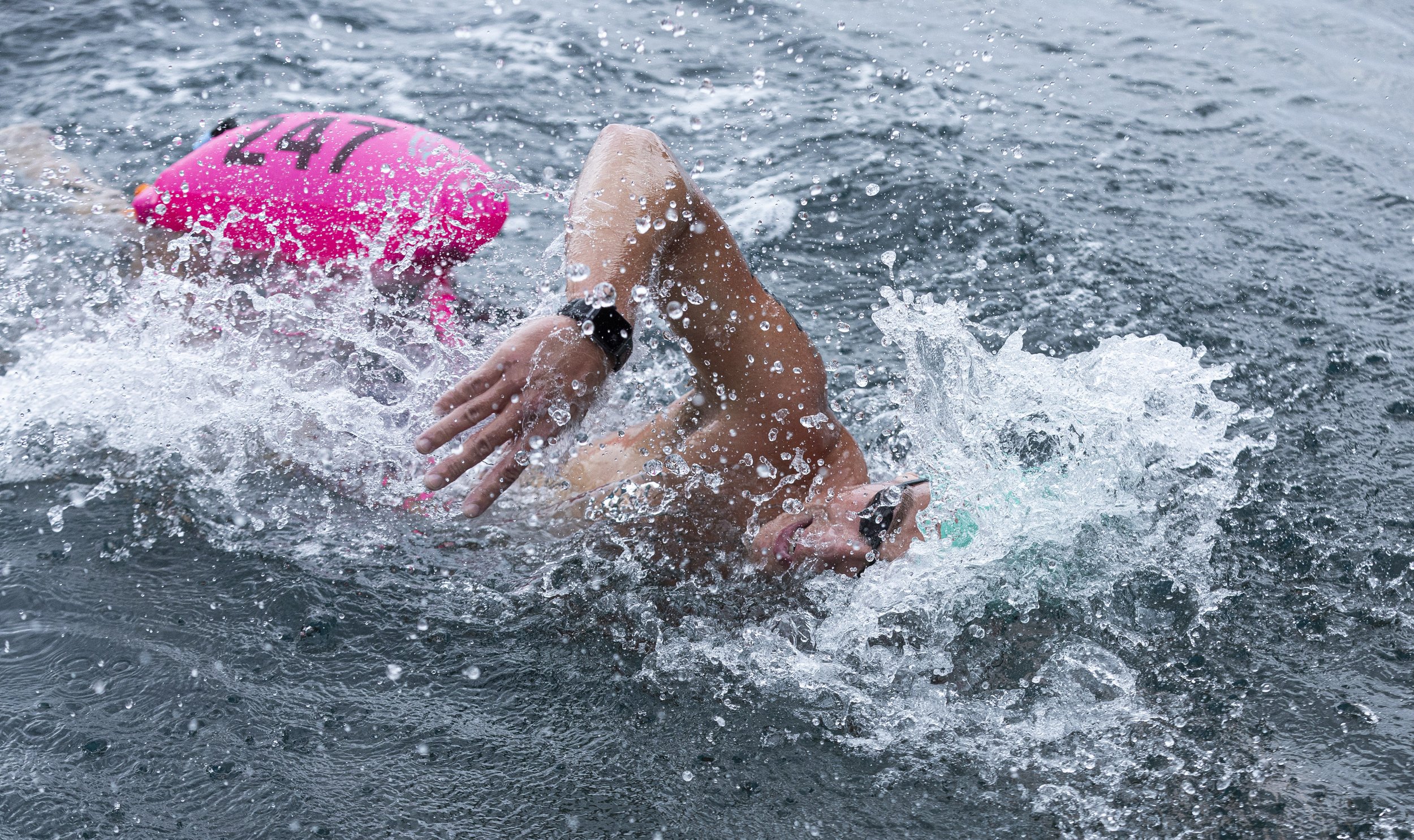
Ivan Puskovitch swimming #5Montenegro
Don’t ignore your core
Core strength cant be underestimated in open water swimming. With longer distanves, having a strong core is essential to maintain efficiency and speed.
“Core strength is the name of the game. When you get tired, your legs start sinking. Good core strength means you are well equipped to keep your hips up when it’s time to race in open water.”
Puskovitch says a pull buoy is a great way to challenge your core strength. The farther the pull buoy is away from your core, the harder it will be to maintain a good position. Start with the pull bouy in the traditional position between your thighs and then progress to holding it between your knees and ultimately between your ankles.
“Not only do you need a lot of lower body endurance to hold it together and not let it slip out, but it creates this canoe like body position if you let your hips sink. So it’s a great way to practice overcompensating for high buoyancy at the shoulder and the feet, but low buoyancy at the hips and it just lets you gather some good core strength
Using a kickboard is another way to achieve a similar challenge for your core strength. “Obviously, kicking is the reason everyone uses a kickboard but you have to focus on keeping your hips up and not letting yourself fall into that canoe shape.”
Just like changing the position of the pull buoy, Puskovitch will change the position of his hands on the kickboard to create more or less difficulty. “You can hold it at the top and rest your arms or as you move your grip further down, you’re getting less support and less buoyancy support from the kickboard.”
Keep your catch
“The last thing I want at the end of the race is to be catching less water than my competition - that’s the biggest reason why people start to pull away from others.”
Puskovitch champions pulling to build strength but also says strong wrists are vital for keeping your catch. “Especially swimmers who use their arms for an extended time, you cannot have weak wrists when you’re pulling. Otherwise, you will miss the water at the beginning of your catch.”
To work on wrist strength, Puskovitch focuses on the start of the catch and uses finger paddles for more water feel.
“I use finger paddles all the time. They are good if you’re doing drills and distance per stroke work to practice flexing the wrist at the start of the catch.”
Unlike larger paddles for strength - based pulling, finger paddles are for “technique driven and mechanically focused” work to hone the correct motion of the catch.
Puskovitch adds that they aren’t just for drills or freestyle. A great way to fully harness the benefits of building wrist strength with finger paddles is using them in all four strokes, especially butterfly. “I use them in all strokes. They’re especially challenging on butterfly. But because you’re starting you’re catch the same way as freestyle, I find it effective for my open water prep.”
This article is from our FLOW magazine, read the full issue to discover more articles, expert tips and testimonials
