Fueling an UltraSwim: Making the Plan Work
How to turn grams per hour into a practical strategy for feed boats, no-feed stages and long swims.

In Part 1, I argued that fueling follows effort rather than speed. That gives us the hourly target.
Part 2 is about execution.
UltraSwim feed opportunities are positioned by distance and can vary by stage and conditions. Your pace therefore determines how long you spend between opportunities to refuel, and that changes how much carbohydrate you may want to take when you get there.
The practical questions are simple: How long will I be swimming? How hard will it be? Where are the feed opportunities? How much should I take at each one? And do I need to carry anything extra myself?
Should I stop at every feed?
For most swimmers, yes.
If a feed opportunity is there, I would generally use it. Stop, take some carbohydrate, have a drink, reset, and then get moving again.
The important point is not that every swimmer must take the same amount. A faster swimmer may reach the station after 45–60 minutes, while someone further down the field may have been swimming for 75–90 minutes. The feed opportunity is the same, but the amount you need may not be.
In Switzerland, the actual race order was a 5.6 km and 5.1 km double on Friday, the 12.6 km lake crossing on Saturday, 5.9 km on Sunday and 4.1 km on Monday. The feed setup varied by stage and conditions.
The 5.1 km Rivaz–Cully swim, for example, had a feed opportunity around 1 km from the finish, but that should not be treated as something UltraSwim necessarily guarantees on every similar-length stage.
So I would build the plan from the actual event briefing and feed layout, then decide how much to take at each stop based on how long you expect to have been swimming and how hard you are working.
At my normal easy pace of just under 2:00/100 m, a 5 km swim takes around 1 hour 40 minutes. I might not need much carbohydrate late in a stage like that, but if an official feed is there, there is little downside to stopping briefly, taking something and hydrating.
Further down the field, the same stop becomes even more important because the time in the water is longer.
So the practical question is less:
“Should I stop?”
and more:
“How much should I take when I get there?”
Should I carry extra fuel and hydration?
Usually, a little, not a lot.
I would use the official feed stations as the backbone of the plan, then carry a small reserve for insurance rather than trying to become self-sufficient in the water.
In Switzerland, I carried two PH chews in my tow float. They were light, easy to carry and gave me another option if a feed was delayed, if I ended up swimming longer than expected, or if I simply wanted something between official opportunities.
The same principle applies to hydration. If the event layout and conditions suggest you may go a long time between drinks, then some personal backup can make sense. But I would not start by designing a complicated tow-float nutrition system unless the specific stage really requires it.
The aim is redundancy, not overengineering.
Three kilometres isn't an hour
The organiser places feed opportunities by distance. Your body experiences that distance in time.
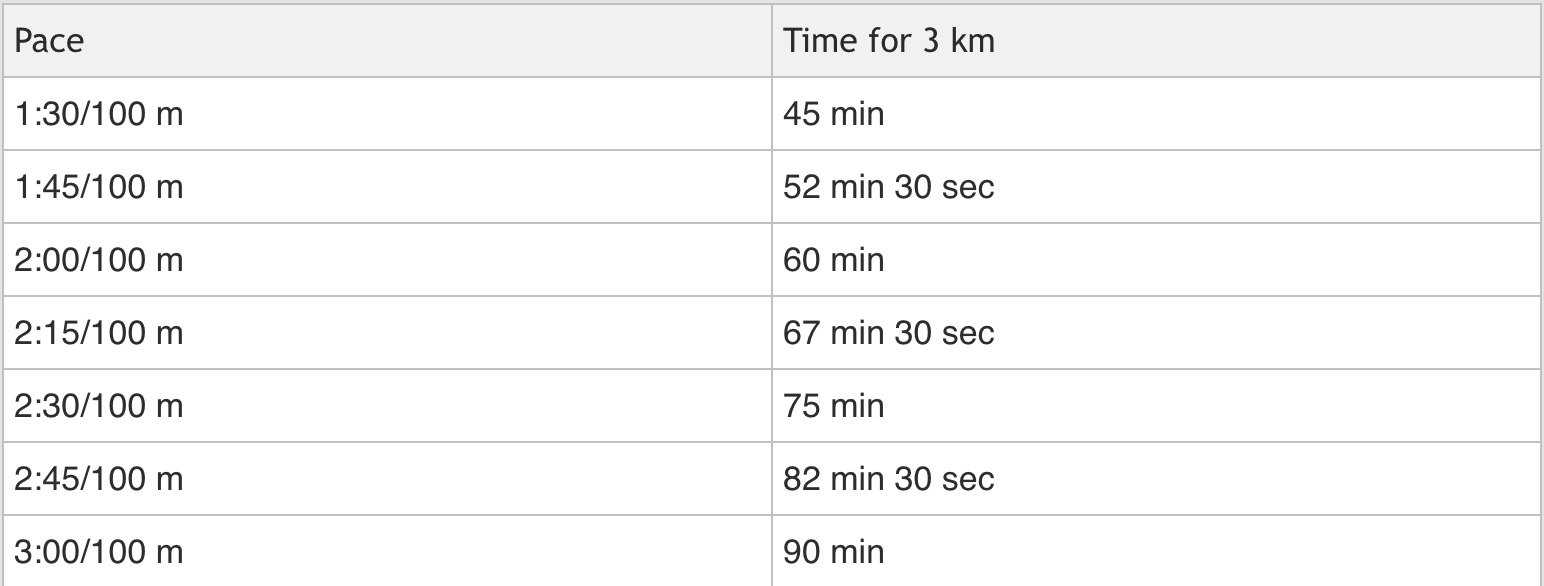
Take a feed approximately every 3 km:
Now imagine every swimmer takes two 30 g products at the station.
At 1:30/100 m, 60 g every 45 minutes works out at around 80 g/h. At 2:00 pace it is 60 g/h. At 2:30 it falls to 48 g/h, and at the 3:00/100 m cut-off it is only 40 g/h.
Same feed opportunity. Same two gels. Very different hourly intake.
That is why pace still matters, even though it does not tell you how hard you are working.
Effort tells you roughly how much carbohydrate you need per hour. Pace tells you how much time passes before the next feed.
My two-gel habit
My normal habit was to take two gels at an official feed, around 60 g of carbohydrate.
At my usual just-under-2:00 pace, that happened to fit very neatly with feeds around 3 km apart. Roughly an hour of swimming, roughly 60 g of carbohydrate.
On the Switzerland crossing I was deliberately staying with a group, so I was slower. The feed stations had not moved, but the time between them had increased. My usual two gels were therefore giving me less carbohydrate per hour.
My solution at the time was to add another feed between official stations.
Looking back, there was an easier option: take three products at the station instead of two.
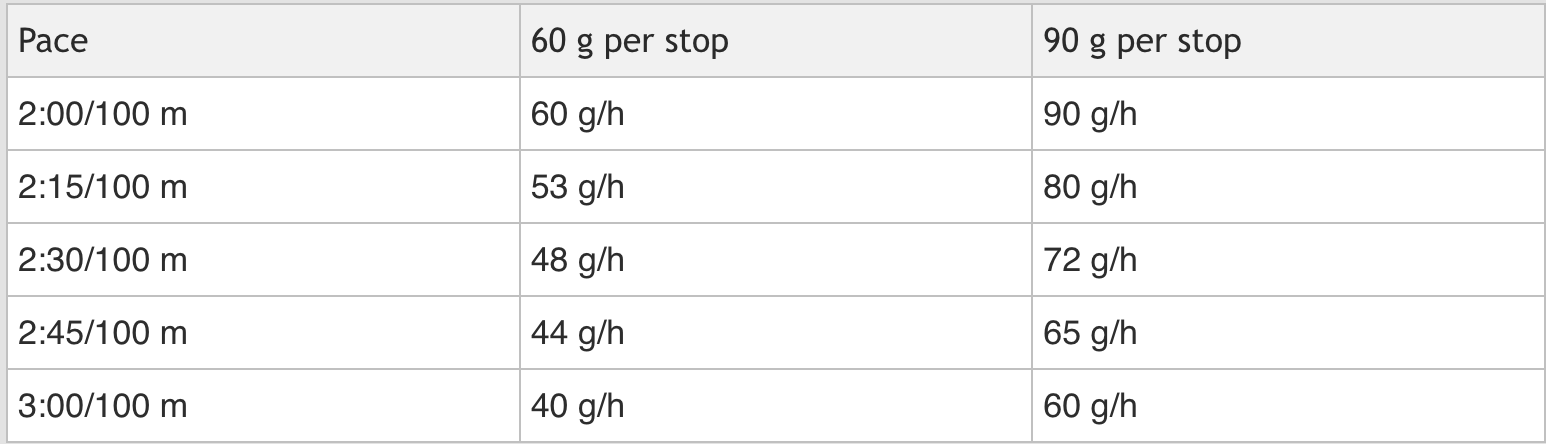
The final line is probably the most useful. Even at the official cut-off pace, 90 g every 3 km averages about 60 g/h.
That means many swimmers can keep the official feed stations as the backbone of the plan without carrying a complicated feeding system. If the gap between feeds is longer for you, the first option may simply be to take a little more when you get there.
One, two or three products?
This is where I would keep it very simple.
If the gap to the next feed is around an hour and you are aiming around 60 g/h, two 30 g products is an obvious starting point.
If the gap is closer to 75–90 minutes, three products may make more sense.
If the stage is short enough that you are comfortably swimming from start to finish without needing much in-water carbohydrate, that does not mean you should ignore an official feed if one is offered. It simply means you may need less when you get there.
The numbers are there to help you make a decision, not create extra work.
Does the timing need to be perfect?
No.
Endurance fueling advice is usually expressed in grams per hour, and athletes often turn that into a rigid instruction to eat every 20 or 30 minutes.
Recent research gives us some reassurance here. A 2025 study compared the same 90 g/h intake delivered as 22.5 g every 15 minutes or 45 g every 30 minutes. The outcomes were very similar.
That does not prove that one giant 90 g dose every hour is identical to smaller feeds. It does suggest that getting an appropriate amount across the hour matters more than hitting an exact minute on the clock.
That suits open-water swimming rather well.
If the boat appears after 65 minutes instead of 60, nothing has gone wrong.
Do I need to drink with a gel?
No.
A gel does not have to be accompanied by water at the same moment.
In swimming, the best opportunity to take carbohydrate and the best opportunity to drink may not always coincide. You can take carbohydrate now and drink later.
You still need to manage hydration across a long swim and across the day. But there is no need to create a rule that says one gel must always equal one drink.
Take carbohydrate when you can. Drink when you can. Manage both across the swim.
“My stomach can't tolerate gels”
Maybe. But I would investigate before accepting that conclusion.
Most gels are concentrated carbohydrate, commonly combinations of glucose and fructose. If you tolerate sweets, soft drinks or other sugary foods, then you already tolerate the same basic carbohydrates. That makes it worth asking what else was happening when the gel caused problems.
Was it during running? Were you working very hard? Were you dehydrated? Had you suddenly increased your carbohydrate intake? Were you also drinking a strong carbohydrate drink? Was it a new product?
Flavor, texture and concentration can absolutely matter, and some products suit some athletes better than others. But the gel itself may not be the whole story.
If you intend to take two or three products at a feed station, practice that before the event.
Do I actually have to use gels?
No.
The body cares about carbohydrate, not the packaging.
Gels, chews, carbohydrate drinks and suitable sweets can all do the job. The attraction of gels at an UltraSwim feed is mostly practical: they are quick to consume, easy to count and give you a known dose.
I used gels at the official feeds and carried two PH chews in my tow float as an emergency reserve. I chose chews because they were light and easy to carry.
That reserve was insurance, not my main feeding system.
What does UltraSwim provide?
I checked this directly with Mark Turner.
UltraSwim's intention is to have enough nutrition at the feed stations for swimmers' needs. The issue is not taking an appropriate amount at a feed, but swimmers stockpiling products beforehand.
Precision Fuel & Hydration supplies the event nutrition, and Mark recommends trying the products before race week. That makes sense. If you think you may want two or three products at a station, you should already know that you are comfortable taking that amount.
The kayaks also carry some nutrition, but the Waterbook tells swimmers not to plan around that supply.
My hierarchy would therefore be:
Official feed stations first. Kayaks as backup. A small personal reserve as insurance.
You do not need to swim carrying a supermarket.
What about caffeine?
Most of the gels I used in Switzerland were caffeinated.
That works for me because I know I tolerate caffeine well. It can help with alertness and perceived effort, which is useful in long open-water swims where concentration matters.
But it is optional.
Repeated caffeinated products can add up quickly, and there is an obvious stage-race trade-off if late caffeine interferes with sleep. If you use it, practice it and know roughly how much you are taking.
The feed doesn't end at the beach
After my swims in Switzerland, I started replacing carbohydrate almost immediately. My first intake was often around 140 g, largely sweets, followed later by proper food.
That is not a prescription. It was simply my way of getting carbohydrate back in quickly.
In a stage event, the finish of one swim is already part of the preparation for the next.
The finish of today's swim is the start of tomorrow's fueling.
The practical plan
If I were building an UltraSwim fueling plan now, I would keep it this simple:
1. Decide roughly how much carbohydrate you want per hour.
For prolonged easy swimming, around 60 g/h is a useful starting point.
2. Look at the actual feed layout for your event.
Use the latest race briefing rather than assuming the layout will follow a fixed rule from another stage or another UltraSwim.
3. Convert those feed distances into time at your normal easy pace.
That tells you how long you are likely to spend between opportunities to refuel.
4. Work out how much carbohydrate you need at each stop.
If the next feed is about an hour away, that may be two 30 g products. If it is 75–90 minutes away, three may fit better.
5. Stop at the official feeds.
For most swimmers, use the opportunity to take carbohydrate, hydrate and reset. The question is usually how much you need, not whether the stop should be ignored.
6. Carry a little backup, not your whole nutrition strategy.
Use the official feeds as the backbone of the plan and carry only what genuinely adds useful insurance.
7. Don't obsess about exact timing.
Think in grams per hour, not perfect 20-minute intervals.
8. Don't tie every gel to a drink.
Manage carbohydrate and hydration across the swim.
9. Practice the actual products and quantity.
If you plan to take three gels at a station, practice taking three gels.
10. Start refueling again as soon as you finish.
In a multi-day event, recovery and fueling the next stage are the same process.
And then the most important bit:
Plan well, practice it, but don't overthink it.
If one feed is ten minutes late, nothing catastrophic has happened. If one hour contains 60 g and the next 75 g, your body is not auditing your spreadsheet.
A good fueling plan should reduce decisions, not create them.
Then go swimming!
MORE FROM THE WATER