Training Tips
Heart Rate and Swimming
Heart rate can be useful in swimming, particularly for distance swimmers. However, it should not be treated in the same way as running or cycling.
Useful Tool or Meaningless Noise?
Tom Jenkinson
TL;DR
Heart rate can be useful in swimming, particularly for distance swimmers. However, it should not be treated in the same way as running or cycling.
Swimming heart rate is usually lower than running heart rate, heart rate responds more slowly, and technical breakdown often occurs before the pulse reaches truly high levels. In swimming, pace, stroke quality, rhythm, and perceived effort still matter most.
The best use of heart rate in swimming is as a measure of cost. Pace tells you how fast you are moving. Heart rate tells you what you are paying for it.
Why Wrist Heart Rate Often Fails in the Water
Many swimmers discover very quickly that wrist-based heart rate data in the pool is messy.
The reasons are obvious once you think about them:
- Water interferes with the optical signal
- Cooler skin temperatures reduce blood flow near the wrist
- Wrist flexion changes during the stroke can affect sensor contact
The result is often erratic data, missing sections, or obviously wrong spikes and drops.
For swimmers who want cleaner heart rate data, a much better option is to use an optical sensor such as the Polar Verity Sense placed under the swim cap.
The head is generally a better location because:
- The sensor stays pressed against the skin
- There is less movement
- Blood flow is more stable
- The signal is more consistent through the session
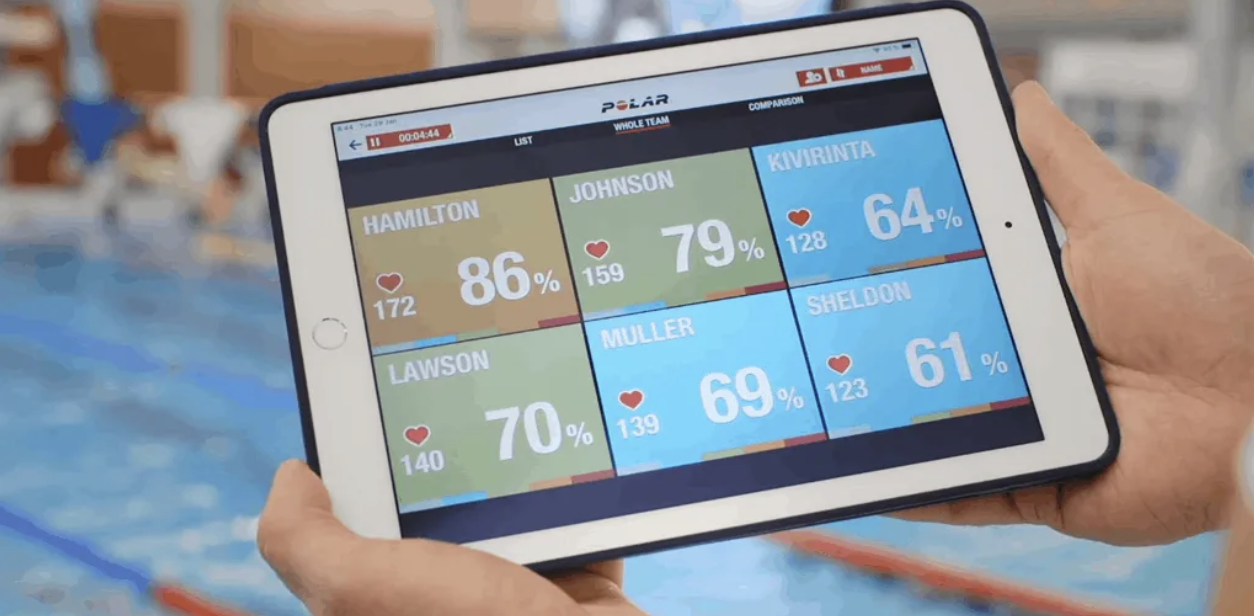
For individual swimmers, this can provide cleaner post-session data. For coaches, it becomes even more interesting when combined with the Polar Team app on an iPad or tablet at the end of the pool.
The Practical Coaching Setup: Polar Verity Sense + Polar Team App
A very practical poolside setup is:
- Each swimmer wears a Polar Verity Sense sensor under the swim cap
- The coach uses the Polar Team app on an iPad or tablet on poolside
- Several swimmers can be monitored simultaneously
- Swimmers can see their pulse live during rest intervals
This creates a coaching environment where athletes begin to understand the relationship between pace, effort, and physiological cost.
The setup is particularly useful for:
- Long aerobic repeats
- CSS threshold sets
- Recovery monitoring between reps
- Long continuous swims
- Comparing how different swimmers respond to the same set
It is less useful for:
- Short sprints
- Very short intervals
- Sets where heart rate never has time to stabilise
A swimmer may complete a hard 50m rep and only see the heart rate peak 15-30 seconds later. That does not mean the rep was easy. It simply reflects that heart rate responds more slowly than pace or power.
Why Swimming Heart Rate Is Different to Running
Most swimmers find that swimming heart rate is lower than running heart rate.
This is normal.
Swimming creates different cardiovascular conditions:
- You are horizontal rather than upright
- Water pressure improves venous return
- Water often cools the body
- There is less total muscle mass involved than in running
- Breathing is more controlled and intermittent
- Anxiety, tension, and disrupted breathing can also change the heart-rate response
As a result, threshold heart rate in swimming is often around 10-15 beats lower than threshold heart rate in running, although the gap varies between athletes.
A runner with a threshold heart rate of 170 bpm may have a swim threshold heart rate of 155-160 bpm, but the only reliable way to know is to observe swim-specific sessions.
However, many swimmers also report that swimming feels harder at a lower heart rate than running.
That is also normal.
Swimming has a much larger local muscular and breathing component. A swimmer may feel technically stressed, air hungry, or muscularly fatigued long before the cardiovascular system reaches its maximum.
This is why swimmers can feel terrible at 155 bpm even though they are comfortable running at 165 bpm.
The Panic Spike: When High HR Is Not Just Fitness
One important coaching point is that a high heart rate in swimming is not always just a sign of metabolic workload.
A swimmer may be nervous, tense, poorly timed in their breathing, or trying to hold a stroke rate they cannot coordinate. In those cases, heart rate can rise partly because of sympathetic nervous system activation: the body’s fight-or-flight response.
That does not mean the swimmer is producing race-level speed. It may mean they are fighting the water, fighting their breathing, or carrying too much tension.
Coaching rule: if the pace is slow but the heart rate is high, check breathing rhythm, body tension, and stroke coordination before assuming the set is simply too hard.
Heart Rate Is Most Useful for Distance and Open Water Swimmers
For sprint swimmers, heart rate has limited value.
For distance swimmers and open water athletes, it can be very useful.
The longer the effort, the more relevant heart rate becomes.
Heart rate is especially useful for:
- Controlling long aerobic sessions
- Monitoring threshold sets
- Tracking cardiac drift
- Identifying fatigue
- Understanding pacing discipline
- Comparing the cost of different pacing strategies
One of the most valuable concepts is heart rate drift.
A swimmer may begin a long set at a sustainable heart rate, but over time the pulse slowly climbs even if the pace stays the same.
This can reveal:
- Poor aerobic durability
- Poor fuelling
- Overheating
- Technique deterioration
- Excessive early pacing
For marathon swimmers, this is often extremely relevant.
The best marathon swimmers are not necessarily the athletes with the highest ceiling. They are often the athletes who can maintain the lowest physiological cost for a given pace.
A useful coaching comparison during long sets is:
- Average HR in the first third
- Average HR in the final third
- Pace change
- Stroke count change
If heart rate rises by 10-15 bpm while pace slows and stroke count rises, that usually indicates fatigue and deteriorating efficiency.
Temperature: The Hidden Variable
Water temperature is one of the hidden variables in swim heart rate.
A pool that is only 1-2°C warmer than usual can noticeably raise heart rate, especially during longer sets or in already-warm conditions. In open water, changing temperature can shift the heart-rate response substantially, which is one reason zones should never be interpreted too rigidly.
This is not always a sign that the swimmer has lost fitness. Sometimes the same pace simply costs more because the body is managing heat, cold, or stress differently.
What the Major Swim Zone Systems Tell Us
If you compare the major swim zone systems used by organisations and coaches such as USA Swimming, British Swimming, Urbanchek, TritonWear, Mujika, and Australian coaching models, one thing becomes obvious:
Most swim systems are not built primarily around heart rate. Instead, they are usually anchored to:
- Pace
- Lactate
- Race specificity
- Stroke quality
- Repeatability
- Perceived effort
This makes sense because heart rate in swimming is slower to respond, usually lower than in running, and heavily influenced by water temperature, technique, tension, and breathing pattern.
The chart below also shows that there is broad agreement across systems around a few major physiological landmarks.
Another interesting pattern is that many swim systems place a surprisingly large amount of emphasis on work above LT1 or above Zone 2 in a simple five-zone endurance mode

This is not especially surprising when you consider the event demands of competitive pool swimming. Many pool events are relatively short, where the decisive work sits well above purely easy aerobic intensity. That creates a very different competitive landscape from running, cycling, or marathon swimming.
In many endurance training models, the majority of work usually sits below LT1 because the events themselves are long and heavily aerobic.
In swimming, especially traditional pool swimming, there is much more emphasis on:
- Threshold work
- VO2 work
- Race-pace training
- Lactate production and tolerance
- Repeated high-intensity efforts
This partly explains why many swim zone systems have multiple categories above LT1 but fewer distinctions below it.
For distance swimmers, marathon swimmers, and open water athletes, this can create a mismatch.
Open water races may last from one to six hours or more, and channel swims can extend far beyond that. These athletes often need a more endurance-oriented model with much more emphasis on low-intensity aerobic work, durability, fuel use, thermoregulation, and pacing discipline.
That is one reason heart rate becomes more useful in marathon swimming than it is in sprint pool swimming. Once the event duration extends well beyond a few minutes, the internal cost of the effort matters much more.
For many open water swimmers, the challenge is not learning how to tolerate high lactate. It is learning how to maintain a low physiological cost for a long time.
- Easy aerobic work below roughly 2 mmol/L
- Threshold work around 3-5 mmol/L
- VO2 and high-intensity work above roughly 6 mmol/L
Different systems use different names and colours, but they are usually describing the same broad physiological ideas.
For example:
- British Swimming splits work into A1, A2, threshold, VO2, lactate production, and lactate tolerance
- USA Swimming uses colour categories such as white, pink, red, blue, purple, and green
- Urbanchek uses colour labels linked to lactate ranges
- TritonWear uses broad endurance and VO2-style zones
- Mujika uses four lactate bands
Note that Zone 2 in many of these systems is what most of you know as Zone 3!
The practical lesson is that heart rate should sit underneath these systems rather than replace them.
For example:
- Long aerobic work should generally correspond with low lactate, easy breathing, and lower heart rate
- Threshold work should correspond with sustainable but elevated heart rate
- VO2 and sprint work may feel very hard before heart rate has time to rise fully
This is particularly important because a swimmer may already be deep into a severe-intensity effort while the heart rate monitor is still showing only moderate numbers.
That is why swimming is usually coached pace-first and heart-rate-second.
Setting Swim Heart Rate Zones
One of the biggest mistakes swimmers make is copying running heart rate zones directly into swimming.
Swimming zones should be built from swim-specific heart rate values.
As a simple starting point:
- Swim maximum heart rate is often around 10 bpm lower than running maximum heart rate
- Some swimmers may need a reduction of 12-15 bpm
If an athlete has a running max HR of 185 bpm, a reasonable swim max HR setting might be 175 bpm.
This is particularly useful in apps like Polar Team that use maximum heart rate to determine the colour zones.
A practical rule is:
- Start with swim max HR = run max HR minus 10 bpm
- Observe how the zones match reality over a few weeks
- Adjust if needed
If swimmers are hitting orange or red during ordinary threshold sets, the swim max HR is probably set too low.
If swimmers remain in green during genuinely hard work, the swim max HR is probably set too high.
For distance swimmers, the colour distribution should generally look like this:
- Recovery and easy aerobic work: blue and green
- Steady aerobic and controlled threshold work: green and yellow
- Very hard efforts and sprint finishes: orange and red
Example Swim Heart Rate Zones
For a swimmer with:
- Running max HR: 185 bpm
- Swim max HR: 175 bpm
A rough practical model might be:
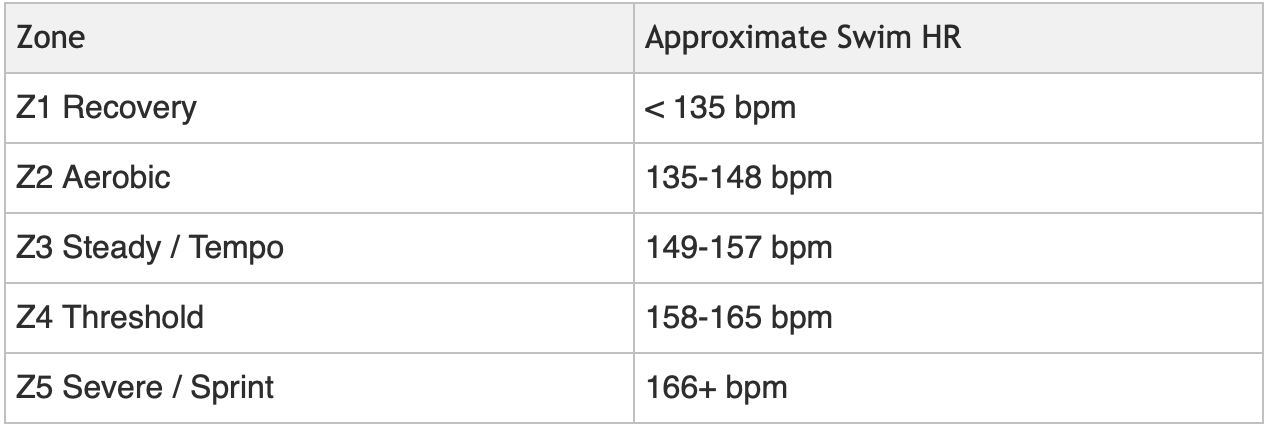
These are only starting points.
The best approach is to compare heart rate with:
- Pace
- % of CSS
- Stroke count
- Stroke quality
- RPE
If all five line up, the zones are probably reasonable.
How to Estimate Swim Threshold Heart Rate
Many swimmers never truly reach maximum heart rate in the water.
Rather than chasing a swim max HR test, it is often more useful to estimate swim threshold heart rate.
A few good options are:
- 3 × 400m at CSS with short rest
- 1000m time trial
- 30-minute continuous threshold swim
- Long broken threshold sets
Take the average heart rate from the final third of the effort.
That is often a good estimate of threshold heart rate in swimming.
For many distance swimmers, swim threshold heart rate is often around 85-90% of swim maximum heart rate.
Summary Checklist for Coaches
Use heart rate to validate the set, not define the set.
- Low HR + low pace: recovery or easy aerobic work
- High HR + target pace: controlled threshold or strong aerobic work
- High HR + falling pace: fatigue, overheating, panic, tension, or technical breakdown
- Low HR + high pace: usually sprinting, anaerobic power, or a lagging heart-rate response
The Coaching Rule
The simplest way to think about heart rate in swimming is this:
Use heart rate to validate the set, not define the set.
For example:
- Aerobic set: pace first, HR confirms it stayed controlled
- Threshold set: pace and repeatability first, HR confirms the cost
- Long continuous swim: HR drift becomes important
- Sprint set: ignore HR, focus on speed and mechanics
Heart rate is not the main anchor in swimming.
It is a supporting variable.
Pace, rhythm, technique, and perceived effort still matter more.
But for distance swimmers, open water swimmers, and marathon athletes, heart rate can be an extremely useful way to understand the internal cost of the work.
In the end, pace tells you how fast you are moving.
Heart rate and other measures tell you what you are paying for it.
This article was written by our affiliate coach Tom Jenkinson. Check out his platform here
MORE FROM THE WATER